What is a B2B SaaS Affiliate Program?
 Written by Joran Hofman, Founder of Reditus
A SaaS affiliate program is a performance-based partnership: people outside your company promote your software through their own channels, and you pay them a commission when a referral becomes a paying customer. Unlike a referral program, the promoters are usually not your customers. This article covers what an affiliate program is and what it is made of. Ready to build one? The full guide is SaaS affiliate marketing: how to start and scale. Unsure what B2B SaaS means? Start with this article.
Who is involved
Three parties, and the program only works when all three get something out of it.
- The SaaS company. You run the program: you provide the tracking, the assets and the terms, and you pay commission when a referral becomes a paying customer. No spend on clicks or impressions that go nowhere.
- The affiliate. A blogger, consultant, agency, newsletter owner or content creator whose audience overlaps with your ideal customer profile. They promote you through their own channels and are paid on results.
- The affiliate's audience. The people who actually buy. They convert better than cold traffic because the recommendation comes from a source they already trust, which counts for a lot in B2B, where buyers check reviews and peer opinions before purchasing.
How a SaaS affiliate program works
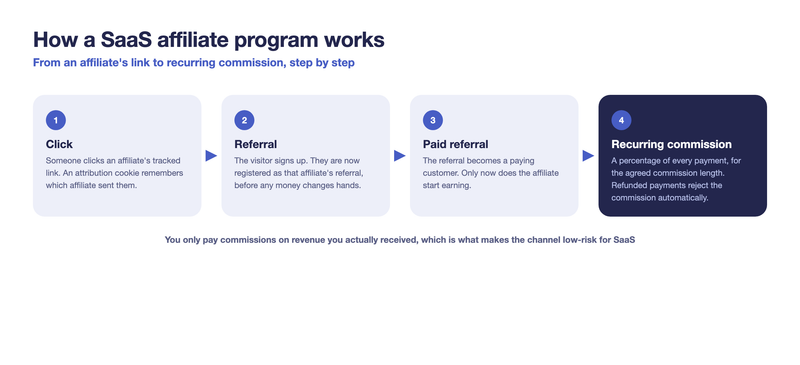
- You set up an affiliate program on Reditus and install the tracking.
- The affiliate gets a personal tracking link, or a coupon code if you use Stripe.
- The affiliate shares the link with their audience: a blog, a newsletter, social media.
- People click the affiliate link and land on your website.
- They sign up for your SaaS. That signup is a referral.
- When the referral pays, a commission is created for the affiliate, on every payment within your commission period.
- On the 1st of each month, commissions that passed your payout threshold go into a payout, and Reditus pays your affiliates once you have paid the monthly overview.
On Reditus the affiliate's link is your website address followed by ?red= and the affiliate's slug, the same slug in every program they join. Want to see how to install it? See the full installation guide. Not sure about launching yet? See when you should launch an affiliate program.
The parts of a SaaS affiliate program
These are the pieces you will meet when you set one up, and the terms people use for them.
- Affiliate program page. The public page that sells the program to potential affiliates: what you pay, how long it runs, what is allowed, and why promoting you is worth their time. It is the first thing a serious affiliate reads.
- Affiliate recruitment. Finding and signing affiliates who already reach your ideal customers, rather than waiting for applications. Start with your own network. See how to find affiliates for your SaaS.
- Affiliate management. Onboarding, assets and the ongoing communication that keeps active affiliates active. See how to manage affiliates.
- Commission models. In B2B SaaS you usually pay a percentage of each payment for a set number of months, sometimes for the customer's lifetime, and commissions usually sit between 20 and 50%. On Reditus affiliates are paid when they deliver a paying customer, not per lead or per demo, and tiers raise the rate as an affiliate brings more paying customers. See affiliate revenue model examples.
- Conversion tracking. The tracking script, the signup snippet and your payment connection tie a paying customer back to the right affiliate. Get this wrong and every other part of the program is guesswork. See installing the tracking script.
- Compliance and terms. What affiliates may and may not do: disclosure, paid ads and brand bidding, prohibited channels, and what happens when someone breaks the rules. See affiliate terms and conditions.
- Commission payouts. Thresholds, schedules and how the money reaches people. Late or unclear payouts cost you good affiliates. On Reditus, automated payouts are on every plan. See how to pay out your affiliates.
- Performance metrics. Clicks, referrals, revenue per affiliate and commission paid. Judge affiliates on the revenue they drive or their earnings per click, not on signups. See how to measure affiliate marketing results.
- Automation. Onboarding emails, commission calculation and payouts that run without you. It saves hours, but don't automate everything: someone still has to recruit, review content and help affiliates earn. See automated onboarding emails.
Why SaaS affiliate programs work
- You pay for results. You pay commission when a referral becomes a paying customer, as a percentage of what they pay. That keeps your customer acquisition cost predictable.
- Recurring revenue, recurring commission. Many programs pay recurring commissions, so affiliates earn as customers keep paying, which rewards them for bringing customers who stay. With Reditus you can motivate affiliates further with multiple tiers.
- Reach through people your buyers trust. Affiliates often have engaged, niche audiences you can't reach cost-effectively yourself. Agencies and consultants who recommend software to their clients are often the quickest early wins, because they implement it for those clients.
- Credibility. When someone your buyer respects recommends your product, it works as social proof. That counts in B2B SaaS, where buyers look for reviews, case studies and peer opinions before purchasing.
- It builds up over time. Good programs get 20 to 30% of their new revenue from affiliates. Getting there takes consistent work on recruiting and activating affiliates, and the channel typically breaks even after 9 to 12 months.
- Room to experiment. You can try different commission levels and affiliate types with less risk than a big ad budget. On top of recurring commission you can pay for specific actions, such as a blog post, a review or a newsletter mention, with campaigns or a one-off commission.
Avoid these common mistakes in affiliate marketing.
SaaS affiliate programs vs referral programs
- Affiliate program: people outside your company, such as bloggers, creators, consultants and agencies, promote your SaaS for commission. On Reditus they sign up for free and get one link slug that works for every program they join.
- Referral program: your existing users recommend you to colleagues and peers for a reward, and grab their link inside your product.
See the key differences in affiliate program vs referral program. On Reditus you can run both, and we recommend launching them together, starting with your own network.
SaaS affiliate program vs influencer program
Both involve someone outside your company promoting you, but they are paid for different things, which changes what you can expect.
- Objective. An affiliate program is built to produce paying customers. An influencer program is built to produce reach and content.
- Compensation. Affiliates earn a commission per paying customer. Influencers are usually paid a flat fee, or given free product, whether or not anyone buys.
- Measurement. Affiliate performance ties straight to revenue. Influencer performance is measured in impressions, engagement and assisted demand, which is harder to attribute.
The two overlap more than they used to. With AI answers taking clicks away from affiliate content, more affiliates ask for an upfront payment next to their commission. An influencer can also be an affiliate: a smaller upfront fee plus a recurring commission. That combination is the hybrid deal covered in the FAQ below.
Best practices for SaaS affiliate programs
Your main question should be: how can I help my affiliates make money? The more they earn, the more revenue they bring you. Keeping that question in mind leads to the following:
- Offer a competitive commission. Do the affiliate's arithmetic: your average deal size times your commission should give them roughly $10 or more per customer payment.
- Give affiliates ready-to-use assets, so promoting you is easy.
- Set clear terms: what is allowed, and when affiliates get paid.
- Recruit relevant affiliates: people with access to your ideal customers in bulk, starting with your own network.
- Track and improve: measure what each affiliate brings, and activate dormant ones with campaigns.
Real results from Reditus customers
- Expandi has generated $2M+ in affiliate revenue via Reditus and grown to 1,700+ affiliates since migrating from FirstPromoter.
- Warmup Inbox tripled its affiliate revenue in 12 months after replacing its in-house affiliate tooling with Reditus.
- TimelinesAI built an affiliate channel from $0 to $130K+ in affiliate-driven revenue with 700+ affiliates.
- Potion reached $30K in total affiliate revenue in the first three months, starting from its own power users.
More in examples of successful SaaS affiliate programs.
FAQ: SaaS affiliate programs
What is a good commission rate for SaaS affiliates?
Commissions in B2B SaaS usually sit between 20 and 50%, mostly as a recurring commission. What fits you depends on a few things:
- Your stage: early-stage companies pay a higher percentage for longer, because affiliates don't know the brand yet. Established programs often pay 20 to 30% for 12 to 24 months.
- How niche you are: the more niche your product, the harder affiliates are to find, so pay a higher percentage or for longer.
- Your deal size: your average deal size times the commission should give an affiliate roughly $10 or more per customer payment.
- Your churn: with high churn, recurring commissions stop quickly and affiliates notice. Fix the churn first.
Design the commission from the affiliate's side of the table, not only from your own margins. More: recurring commission affiliate programs.
How do affiliates promote SaaS products effectively?
Common channels are blogs, LinkedIn, YouTube tutorials, comparison sites and newsletters that reach your ideal customers. The most important check: do they have access to your ideal customers? If they do, see whether they can combine their channels, for example content plus social plus personal recommendations.
What's the difference between recurring and one-time commissions?
A recurring commission pays the affiliate on every payment the customer makes during the commission period. A one-time commission is a single payment, for example for a blog post, a newsletter mention or a video. You can combine them, which makes it a hybrid deal. Recurring works best when your customers stay.
What is a hybrid deal in affiliate marketing?
If you want an affiliate to write a blog post, add you to a newsletter or to a listing article, they may ask for an upfront payment. Pay that plus a recurring commission and you have a hybrid deal. Keep the upfront part modest, so their big reward comes from the paying customers they bring. On Reditus, campaigns handle the upfront part: you pay a bonus when the work meets your rules. More: why SaaS affiliate marketing is going hybrid.
How long should the cookie window be?
Each program sets its own. New programs on Reditus start at 60 days, many programs use 30 days, sometimes 60, and the maximum is 365. Typically no cookie consent is needed for the Reditus cookie, because it only records whether a signup came via an affiliate and builds no visitor profile. This is based on the opinion of a Dutch lawyer and may not apply in every country, so check your own local regulations. Learn more.
Can I run both referral and affiliate programs together?
Yes. Referrals come from your existing users, while affiliates reach people outside your network. On Reditus both run on the same tracking, and the last click before signup decides who gets the referral. See more about running the two programs together.