Referral Program vs Affiliate Program: The Difference for SaaS
The difference is who promotes you. A referral program rewards people who already use your product for introducing someone they know. An affiliate program rewards outside promoters, who usually are not customers, for sending you traffic that converts. Everything else, the rewards, the payout model, the volume you can expect and the work it takes to run, follows from that one distinction.
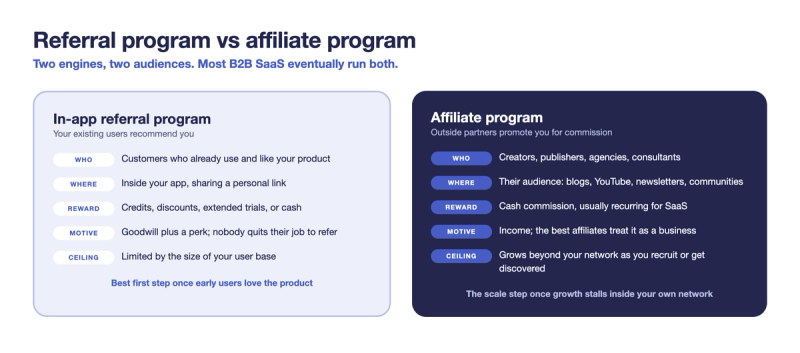
Referral program vs affiliate program, side by side
The dimensions that actually change how you run each one:
- Who promotes you. Referral: existing users, invited from inside the product. Affiliate: anyone who applies, most of them not customers.
- Motivation. Referral: they like the product and want to share it, the reward is a nudge. Affiliate: income, and it competes directly with every other program they could promote instead.
- Reward shape. Referral: usually credits, a discount, an extended trial or extra features, and often double sided so the invited person gets something too. Affiliate: cash commission, in SaaS almost always a percentage of revenue.
- Payout duration. Referral: typically one reward per successful invite. Affiliate: recurring for a fixed term, most commonly 12 months, sometimes for the customer's lifetime.
- Volume per promoter. Referral: low, a few introductions each, but many possible referrers. Affiliate: highly uneven, a small number of partners produce most of the revenue.
- Lead quality. Referral: high, the referrer knows both sides. Affiliate: varies with the partner, which is why the terms and the channel rules matter.
- Where it lives. Referral: inside the product, as a widget or a share screen. Affiliate: a public landing page plus an application and approval flow.
- Ongoing work. Referral: mostly a setup and placement job, then it runs. Affiliate: continuous recruiting, onboarding, enablement and payouts.
- What has to be true first. Referral: you need happy paying users. Affiliate: you need a product with enough brand and conversion rate that a stranger believes their traffic will convert.
Why the difference in who joins changes everything
A referral program is offered in-app, so only your users see it. They refer you because they use the product and the recommendation costs them nothing socially. The reward helps, but it is not why they do it. That is why credits, discounts and extra features work as well as cash here, and why a double sided offer, where the invited person also gets something, lifts conversion: it gives the referrer a reason to send the link that is not about their own payout.
An affiliate program is open, so the people who join are choosing between you and every other program in their niche. They are money motivated by design. That means your offer is judged commercially: the commission rate, how long it runs, whether your product converts the traffic they already have, and whether they can get access to use it. A generous rate on a product that does not convert is worth nothing to them, so recruiting is a sales job, not a signup form.
If you want the same comparison written for the strategy question rather than the definition, see SaaS affiliate vs referral program.
What each one typically pays
Referral rewards in B2B SaaS are usually account credit worth roughly one month of the plan, a percentage discount for both sides, a trial extension, or a feature unlock. Cash is possible but often a poor fit, because credit keeps the value inside the product and costs you less than its face value.
Affiliate commissions in B2B SaaS cluster at 20 to 30% recurring, with some programs up to 40% and a few higher. Duration matters as much as the rate: 25% for 24 months is a stronger offer than 40% for six months on most price points. The detail, including which programs pay recurring and for how long, is in recurring commission affiliate programs.
Which should you launch first?
For an early stage SaaS, start with the in-app referral program. Your existing users already understand the product, so there is no education to do, and you are not asking anyone to bet their audience on a brand they have never heard of. At that stage it is genuinely hard to recruit affiliates, because the honest answer to their first question, will this traffic convert, is not yet a confident yes.
Move to an affiliate program once you have product-market fit and a conversion rate you can quote. The clearest signal is that people outside your own network start recommending you unprompted. Before that point, an affiliate program mostly produces signups from partners who never send a single click.
Longer versions of both calls: should you start with referrals or affiliates first and when should a SaaS launch an affiliate program.
Can you run both at the same time?
Yes, and most established SaaS companies do. They target different audiences and rarely compete for the same person. The one thing to settle up front is what happens when a customer qualifies for both, for example a user who is also an approved affiliate: decide which program the conversion belongs to and write it into your terms. See running referrals and affiliates together for how to keep the attribution clean.
Frequently asked questions
Is a referral program the same as word of mouth?
No. Word of mouth happens anyway. A referral program makes it trackable and rewards it, which is what turns an occasional recommendation into a measurable channel you can report on.
Do affiliates have to be customers?
No, and most are not. Giving them product access anyway is worth it: affiliates who have actually used the tool write better content and ask your team fewer questions.
Which one brings more revenue?
An affiliate program has the higher ceiling, because a single strong partner can send more customers than hundreds of individual referrers. A referral program is more reliable and cheaper to run, and it compounds as your user base grows. They are not substitutes.
What about partner programs and technical partners?
They are the other two indirect channels. A partner program covers resellers and agencies who sell or implement on your behalf, usually with a contract and a margin rather than a public commission. Technical partners are integrations, where the value is the product connection and the co-marketing around it, not a payout. Both take far more setup than a referral or affiliate program, so they normally come later.
Related articles
- What is an in-app referral program?
- Benefits of running a referral program
- How to set up the in-app referral program
- SaaS affiliate marketing: the full guide
Going with referrals? The referral strategy guide covers what to offer and where programs fail.