SaaS Affiliate Program Checklist: 10 Steps to Launch Successfully (2026)
Ready to launch a SaaS affiliate program? Follow this checklist to cover every step for a successful launch and avoid the problems that surface months later. It is based on what we see across hundreds of B2B SaaS affiliate programs running on Reditus.
Prefer a printable version? Download the free 10-step launch checklist (PDF) and tick off each step as you go.
Before you start: is an affiliate program the right next step?
An affiliate program is not a magic bullet, and it is not the way to get your very first clients. But if you do have your first happy customers, there is a step that comes even before affiliates: an in-app referral program. Your existing users already know your value. Let them recommend you from inside the product: they do not need to sign up to a third-party platform, you can reward them with in-app benefits (credits, extended trials, discounts), and you create a viral loop that makes your product stickier while it grows. See our full guide to setting up an in-app referral program.
Once people outside your own user base should start promoting you, the affiliate program is the next layer. Here is the 10-step launch checklist.
The short version: three signals you are actually ready
Before the ten steps, here is the honest readiness test we apply after seeing hundreds of programs launch. You are ready when three things are true:
- You have paying clients. Affiliate marketing cannot be your first go-to-market channel. If nobody pays for your product yet, you will not convince anyone to recommend it.
- You have run paid ads yourself. Spending your own money on traffic forces you to know your conversion rates, from click to signup to paid. If you do not know those numbers, you cannot tell an affiliate what to expect, and their traffic will not magically convert better than yours did.
- People already recommend you. Customers mentioning you, a partner sending the occasional lead, anyone asking about a referral deal: these signals mean the channel has something to amplify.
One more thing worth doing before launch day: identify who your ideal affiliates would be and reach out to a few of them directly. Getting even a handful of relevant people committed before you launch, possibly with a small upfront incentive to create their first content, activates the channel far faster than launching to an empty room.
The check we run on your site before we answer the question
When a company asks us whether they are ready, we look at their website while they are still talking. It takes about fifteen seconds and it is a useful thing to run on yourself before you start.
- Above the fold. Customer logos, review scores, social proof of any kind. Companies without paying customers have none, and the section usually looks unfinished.
- The menu bar. A thin nav usually means there is not much behind it yet.
- The footer. A full footer with social profiles, privacy policy, terms and a DPA says a company has been operating for a while. An empty footer says the opposite just as loudly.
Two answers stop the conversation for us. The first is not having any paying customers yet, because at that point an affiliate program is the wrong thing to be building. The second is wanting to list in a network while having no intention of inviting your own existing users. If you would not ask the people who already use your product to recommend it, it is difficult to ask strangers to do it for you.
Step 1: Define clear goals and KPIs
Decide what success looks like before launch: affiliate-driven signups per month, revenue contribution (% of MRR), CAC via the affiliate channel, and the activation rate of new affiliates. Top programs track the full funnel: click, signup, paid referral, and LTV of affiliate-referred customers.
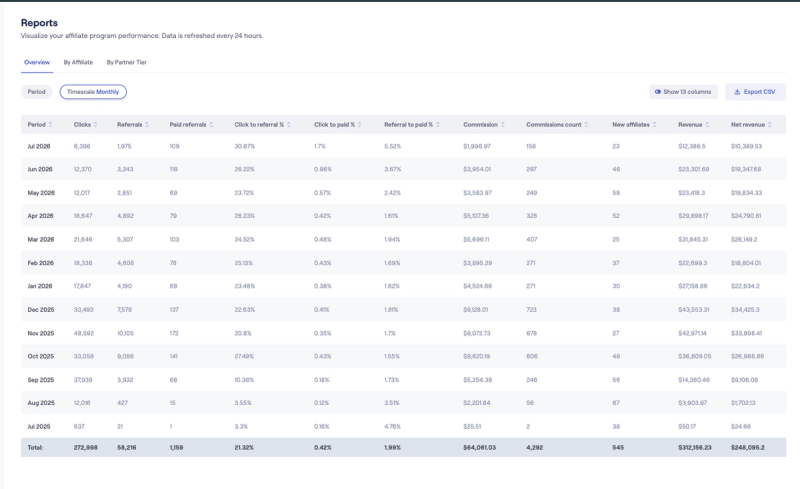
Benchmark: mature SaaS affiliate programs get 10-30% of approved affiliates to become active promoters. If your activation rate is much lower, it usually points to onboarding, asset, or commission issues.
Also set timed goals: X affiliates within 3 months, affiliate channel contributing Z% of new ARR within 6 months. These make it easy to evaluate and adjust quickly.
Step 2: Validate product-market fit and customer retention
Ensure conversion from trial to paid is stable (20-30% is solid traction; below 5-10% affiliates will promote but see little return and leave). Study your churn: with recurring commissions, high churn means commissions stop quickly, and affiliates notice. Use feedback from early customers to make sure messaging, features, and support are solid, because affiliates will amplify your positioning, good or bad.
Step 3: Assess financial viability
Compute your LTV, CAC, and margins, and model commission payouts against cash flow (simulate slow adoption and high churn scenarios). As a rule of thumb, SaaS programs commonly allow 10-30% of customer lifetime value for affiliates. Remember: with affiliate marketing you only pay commissions after you received a payment.
Want to model what the channel could realistically deliver, and when? Use our free affiliate revenue timeline calculator.
Step 4: Build tracking and the technical setup
Make sure tracking is fully automated and affiliates get multiple ways to promote you (links and coupon codes). The setup with Reditus has three parts:
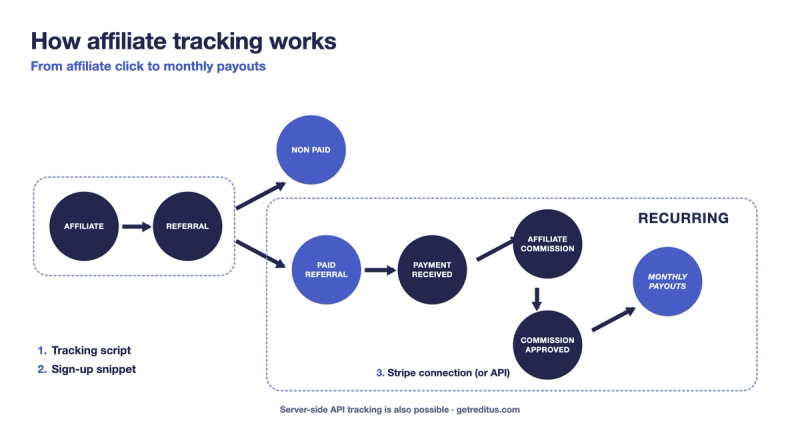
- 1. Install the tracking script: places the attribution cookie when someone clicks an affiliate link (guide). Good to know: you do NOT need to ask for cookie consent for the Reditus cookie; it is an attribution-only cookie, no PII (why).
- 2. Install the sign-up snippet: registers the referral when someone signs up (guide).
- 3. Connect Stripe or the API: with Stripe this works out of the box, including automatic commission rejection when a payment is refunded. Via the API you can send us refund data.
Choose your cookie window (60-90 days is typical for SaaS). The window only covers click-to-signup; once someone becomes a referral there is no time limit anymore. Full details in the installation guide.
Step 5: Legal terms, commission models and policies
Provide a clear written affiliate agreement covering commission type, payout schedule and thresholds, refund policy, permitted promotional channels (no trademark bidding, no spam, no misleading claims), and disclosure requirements. Use our agreement template as a starting point (make a copy).
Practical policies you can enforce in Reditus directly: exclude specific products or subscriptions from generating commissions (via Stripe product metadata), and automatically reject referrals generated through paid ads on your brand terms if you do not allow ad bidding (paid ads policy). Also remember to add Reditus as a sub-processor in your privacy terms.
Ready to see it in practice? Start a 14-day free trial (no credit card) or book a demo and we will walk through your launch plan with you.
Step 6: Design an attractive commission structure
Decide on your commission model: one flat percentage, or tiers that reward performance. With Reditus you can create public tiers where affiliates automatically earn more as they deliver more, plus private tiers for special deals with consultants, agencies, or influencers, without showing those terms publicly.
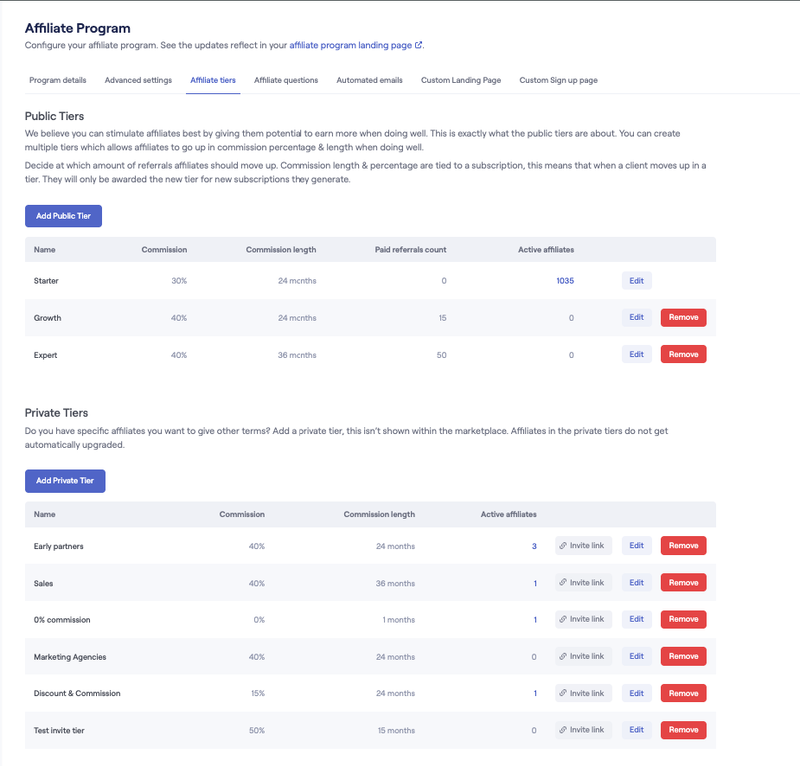
On top of the base commission, use one-time bonuses for specific actions: write a blog post, publish a review, create a video. Want to reward the referred customer too? Use webhooks to automatically assign a discount, extended trial, or credits in your own system.
Not sure what to offer? Browse the Reditus marketplace to see what other B2B SaaS companies offer affiliates, or check the 23 programs currently running on the network for real commission examples.
Step 7: Prepare marketing and affiliate assets
Ready-to-use assets let affiliates start promoting quickly, and keep everything on-brand. A good resource folder includes: logos, product screenshots, banners, explainer videos, product walkthroughs, your ideal customer profile, and a list of your best-performing content and keywords.
Want to take it a step further? Create an AI content agent for your affiliates, trained on your own product facts (a "truth document" describing exactly what your product does and does not do). Affiliates ask it for any content they need, and the output stays accurate and on-brand because it is grounded in facts you control. It is the fastest way we know to get quality affiliate content live at scale.
Step 8: Onboarding and supporting your affiliates
Most affiliates who join a program never promote anything. Onboarding is what turns signups into active promoters:
- Set up the automated onboarding sequence in Reditus: welcome email, tutorial, FAQs, contact point.
- Send affiliate data to your CRM via our integrations (HubSpot, User.com) to use your own email flows.
- Invite your own network and partners first: they already know your product and give the program a running start.
- Add "Affiliate program" to your site footer and create a landing page for it.
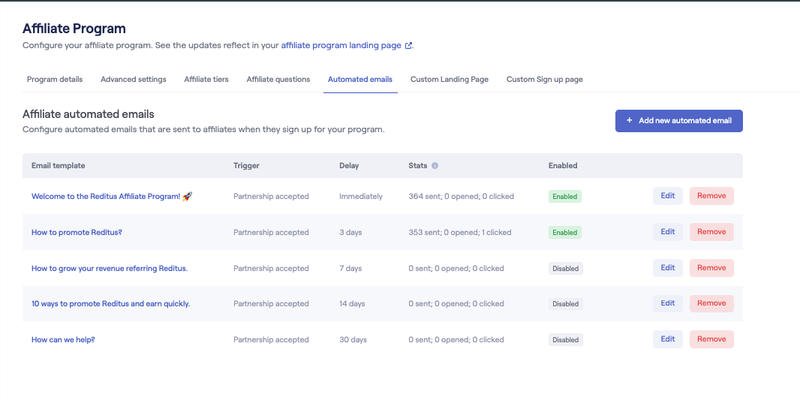
Then keep the momentum: monthly updates, content prompts, and promotional ideas. Programs with regular communication see far higher affiliate retention.
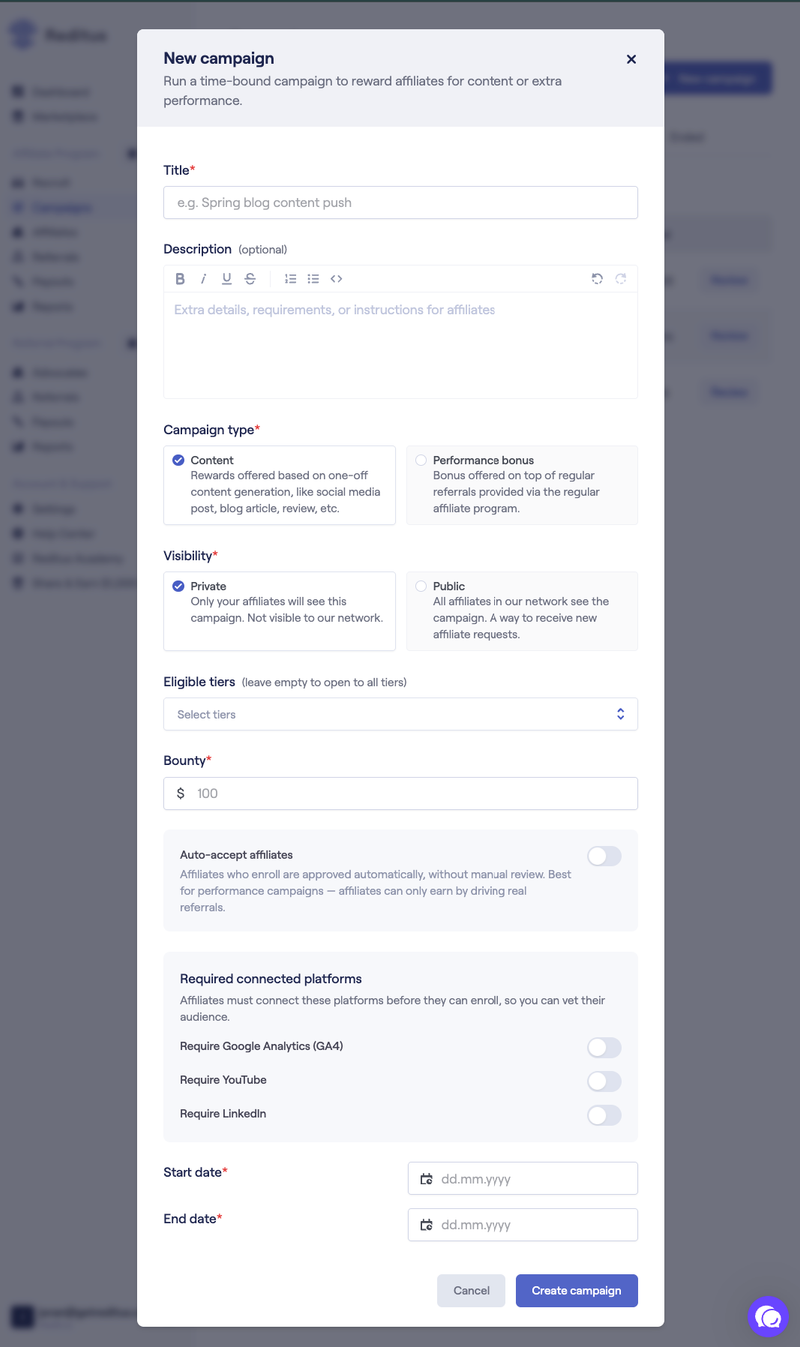
The fastest activation lever: Campaigns. Pay affiliates upfront for specific actions ("write a comparison post this month, get a $50 bonus") while they keep earning recurring commissions. Campaigns activate dormant affiliates and get you discovered by new ones.
Step 9: Set up monitoring and feedback loops
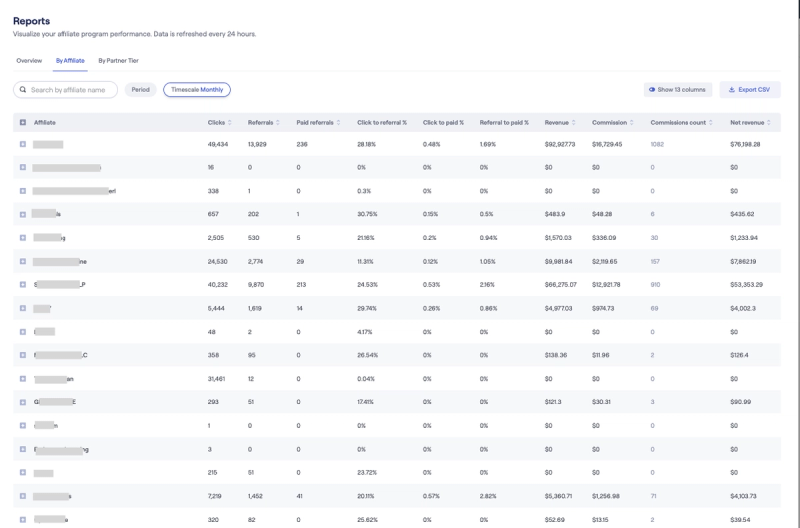
Plan weekly or monthly reviews: affiliate activity, conversion rates per affiliate, passive vs active affiliates. The Reports section in Reditus gives you the full funnel per period (see Step 1), including a per-affiliate breakdown, so you can segment affiliates and target dormant ones with campaigns while pushing active ones to do even more.
Step 10: Post-launch review and iteration
Do a 30-90 day check: is the affiliate channel delivering expected revenue? Are commissions sustainable? Adjust commission structure, targeting, or messaging as needed. Affiliate marketing is not set and forget: experimenting is how you find the sweet spot for your SaaS.
After launch: help your first affiliates make money
The most common failure mode after launch is not technical. It looks like this: affiliates sign up, weeks pass, nothing happens, and the company concludes that affiliate marketing does not work. When you dig in, the company never reached out to those affiliates and never helped them earn anything.
The one question that decides whether your program works is: how can I help my affiliates make money? Answer it concretely, then do the unscalable work. Treat launching an affiliate program like launching a SaaS: talk to your first affiliates constantly, ask what they need, and make it your mission to get the first five to ten of them earning as quickly as possible.
It feels counterintuitive to work this hard for a channel that is supposed to bring you customers. But once you know how to make an affiliate successful, you can automate and repeat it at scale. Automating before you know that is automating a process that does not work. And do not overthink the commission percentage in week one: launching and talking to real affiliates will teach you more about the right offer than any spreadsheet.
What actually happens across a six-week launch
The technical installation takes under half an hour, which raises an obvious question: where do the other five and a half weeks go? Here is the honest breakdown from the launches we run.
Week 1: the foundation, most of which is not technical
Installation, then everything around it: your tier structure, the program landing page, the affiliate agreement, your onboarding emails, and the promotional materials affiliates will actually use. Increasingly this also means giving affiliates an AI assistant that can tell them what content to make for you, which is what we run at chat.getreditus.com for our own program.
Weeks 2 to 4: recruitment, and this is where the time really goes
There are two paths, and the same groundwork applies to both. Listing in a marketplace brings people to you, but you still want the right people arriving, so do not skip the setup work just because inbound is coming.
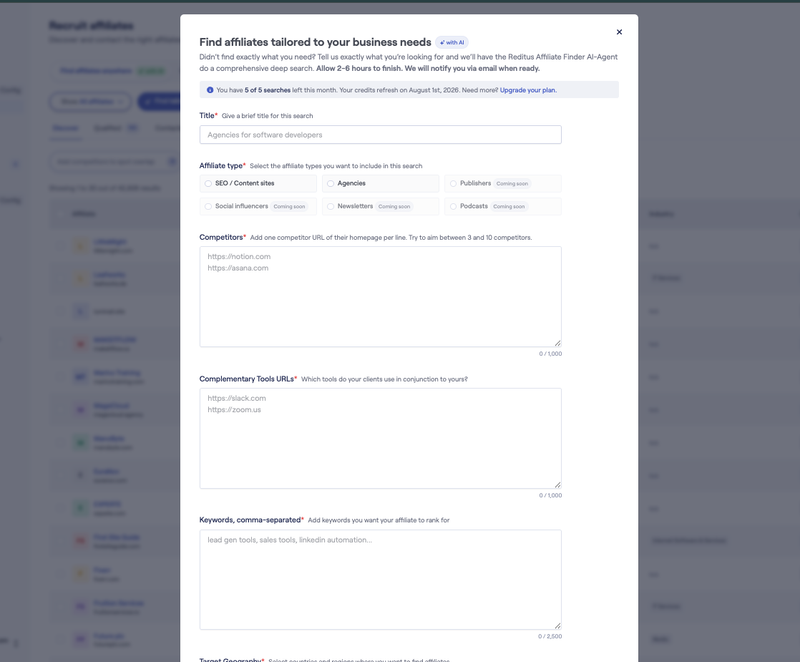
- Outbound: run AI discovery against your target profile, your competitors' affiliates, and the people already ranking for the keywords you want to own, then reach out.
- Warm: your own user base, your newsletter, your footer, and any consultants or agencies already using your product, who should be approached differently from cold prospects.
Start with the warm circle. With a stranger you first have to convince them your product is worth recommending, and that is the slow part. People who already know you skip that step, which is how you break the ice quickly.
Weeks 4 to 6: activation, and the timeline it produces
Once people are joining, the question changes from how do I get affiliates to how do I get these affiliates to do something. That is where incentivised content comes in: paying for the article, the listicle or the video rather than waiting for it.
What that sequence should produce: month one is recruitment and almost nothing else, first clicks arrive in month two, and the first referrals land at the end of month two or the start of month three. Qualifying your affiliates comes after that, based on what they have actually done rather than what they said they would do.
Choose your tech wisely
One more decision that determines whether this checklist pays off: the platform you launch on. Any tool can track referrals. The question is what happens when your own network runs out. If you want a channel that scales, look for a built-in affiliate network where affiliates discover your program (Reditus: 28,000+ B2B SaaS affiliates), AI affiliate discovery to find new partners, Campaigns to activate them, and an in-app referral program to capture your own users, all in one platform.
See how Reditus compares to the alternatives and what the network brings from day one.
FAQs for launching your affiliate program
What minimum revenue should I hit before launching an affiliate program?
As a rule of thumb, from roughly $10K MRR the channel can work: you have proof people pay, conversion data, and enough margin to fund commissions. Earlier than that, start with an in-app referral program to leverage the users you already have.
How long does it take to see results from an affiliate program?
Affiliate programs typically take 3-6 months to build momentum: recruiting, onboarding, and content creation all take time. You are adding two layers to your funnel (recruit affiliates, then they promote you). Want a realistic projection for your specific numbers? Use the free affiliate revenue timeline calculator.
How does Reditus help me get results faster?
Three ways: list your program in the marketplace so 28,000+ B2B SaaS affiliates can discover and apply to it, use the AI discovery agent to find affiliates who already promote products like yours, and run campaigns that pay affiliates upfront for content. That shortens the recruit-and-activate cycle dramatically.
What payout threshold should I use?
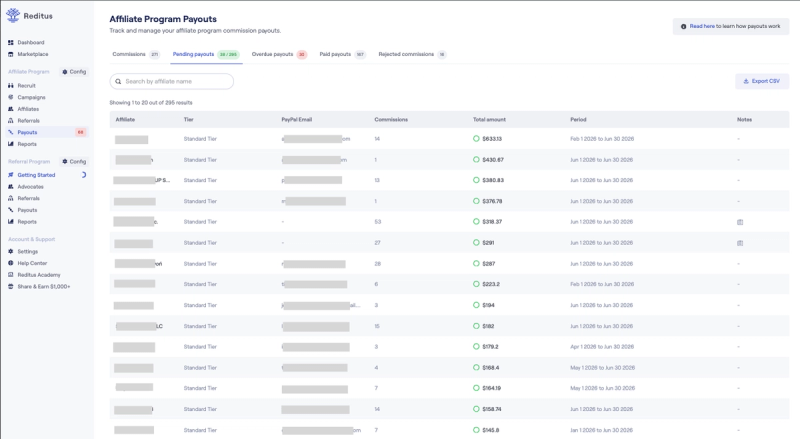
Many SaaS programs use a threshold of €50-€200 and pay monthly. In Reditus, commissions accumulate into a payout generated on the 1st of the month, and affiliates are paid once the accumulated amount passes your threshold.
What happens to commissions when a customer refunds or cancels?
Why are my affiliates not doing anything?
Inactive affiliates are the single most common problem in SaaS affiliate programs: people sign up and never create content. The fix is rarely more affiliates. Reach out personally, help them understand how to earn with your product, and give them something concrete to do. Increasingly, programs also pay a small upfront amount for a first piece of content, which is the core idea behind hybrid affiliate deals.
When a referral cancels, no further commissions are generated. Commissions are only created when you actually received a payment. On Stripe, refunds automatically reject the related commission if it has not been paid out yet; via the API you send us refund data.